
Passive Income Investment Strategies USA for Long-Term Wealth
Building passive income has become one of the most effective ways to achieve financial independence. Rather than relying solely on earned income, investors can create multiple revenue streams that continue generating cash flow with minimal daily involvement. For professionals, entrepreneurs, and retirees in the United States, passive income investment strategies offer opportunities to grow wealth while reducing dependence on active employment.
Successful passive investing requires more than selecting high-yield investments. A comprehensive strategy combines diversification, tax planning, risk management, asset allocation, and long-term financial planning. Working with experienced financial professionals helps investors design portfolios that balance consistent income with sustainable capital growth.
Why Passive Income Matters
Passive income creates financial flexibility and reduces dependence on a single income source. It can supplement retirement income, support business expansion, fund education, or accelerate wealth accumulation while providing greater financial stability during economic uncertainty.
- Create recurring cash flow.
- Build long-term financial independence.
- Diversify income sources.
- Reduce financial stress.
- Support retirement planning.
- Grow wealth over time.
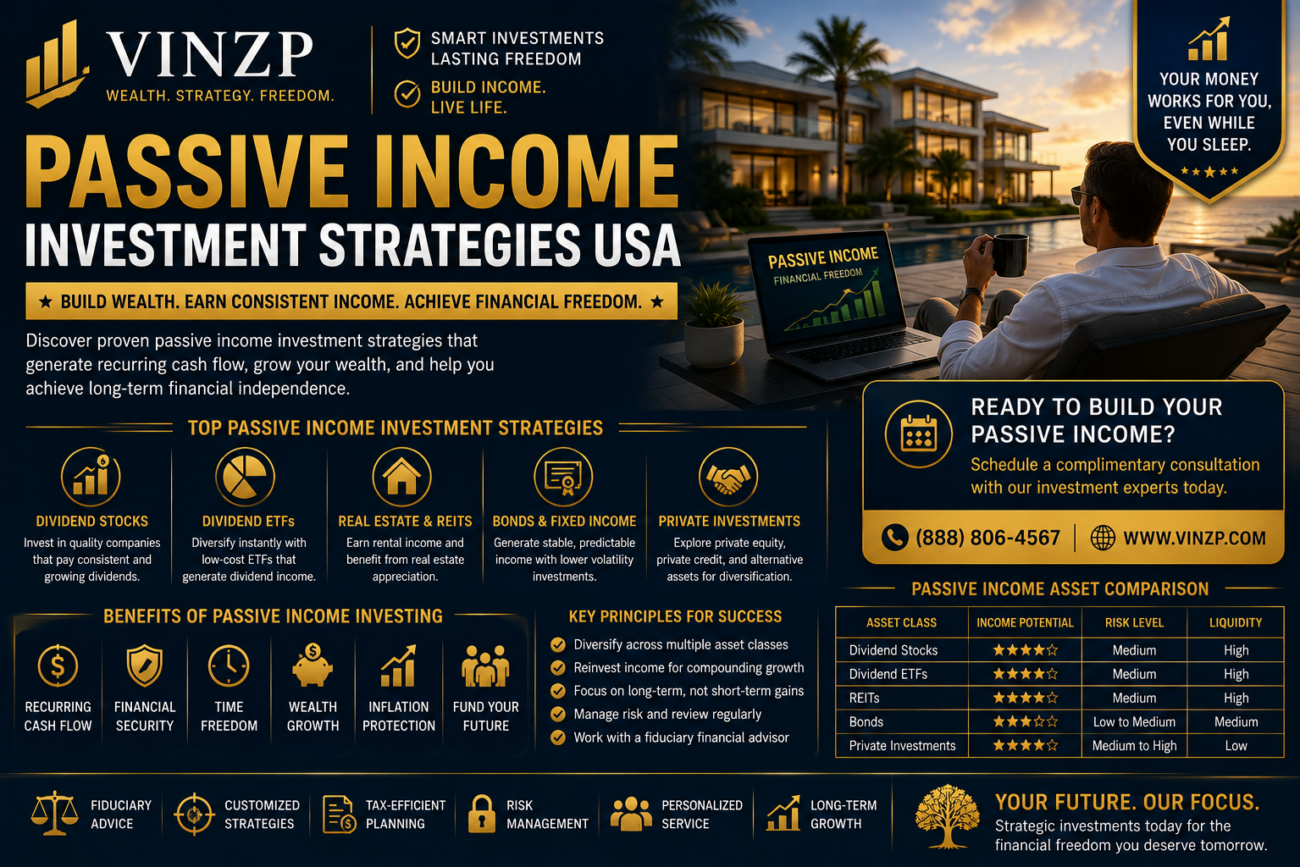
Top Passive Income Investment Strategies USA
Dividend-Paying Stocks
High-quality dividend stocks provide regular income while offering long-term capital appreciation. Companies with strong financial fundamentals and a history of increasing dividends often become core holdings for income-focused investors.
Exchange-Traded Funds (ETFs)
Dividend ETFs and broad-market ETFs provide instant diversification while generating income through dividend distributions. They offer a convenient way to reduce concentration risk and lower investment costs.
Real Estate Investments
Rental properties, Real Estate Investment Trusts (REITs), and private real estate funds generate recurring income while providing potential appreciation and inflation protection.
Fixed-Income Investments
Government bonds, municipal bonds, corporate bonds, and certificates of deposit provide predictable income with varying levels of risk and return.
Private Investment Opportunities
Qualified investors may diversify into private equity, private credit, infrastructure, and other alternative investments to complement traditional portfolios and potentially enhance long-term returns.
Comparing Passive Income Assets
| Investment | Main Benefit | Risk Level |
|---|---|---|
| Dividend Stocks | Growing income | Moderate |
| Dividend ETFs | Diversification | Moderate |
| REITs | Real estate exposure | Moderate |
| Bonds | Stable income | Low to Moderate |
| Private Investments | Portfolio diversification | Moderate to High |
Managing Risk Through Diversification
No single investment should become the sole source of passive income. Diversifying across multiple asset classes, sectors, and geographic regions helps reduce volatility while improving the consistency of portfolio income.
Investors looking for customized portfolio solutions may also explore Private Investment Management Services to build diversified income-producing portfolios.
Tax-Efficient Income Planning
Taxes significantly influence investment returns. Strategic asset location, capital gains planning, qualified dividend management, and retirement account optimization help maximize after-tax passive income.
For advanced tax strategies, consider reviewing Tax Planning Services for High-Income Earners to improve long-term investment efficiency.
Common Passive Investing Mistakes
- Chasing extremely high yields.
- Ignoring portfolio diversification.
- Failing to reinvest excess income.
- Neglecting tax planning.
- Investing without clear financial goals.
- Making emotional investment decisions.
Benefits of Professional Investment Guidance
Financial advisors evaluate your income objectives, risk tolerance, tax situation, and investment timeline to develop a personalized passive income strategy. Ongoing portfolio reviews and disciplined asset allocation help maintain long-term financial stability despite changing market conditions.
Frequently Asked Questions
What is passive income investing?
Passive income investing focuses on assets that generate recurring cash flow, such as dividend stocks, ETFs, bonds, REITs, and other income-producing investments.
Is passive income completely risk-free?
No. Every investment involves risk, but diversification and disciplined portfolio management help reduce overall investment volatility.
How much capital is needed to start?
Investors can begin with relatively small amounts through ETFs or dividend-focused mutual funds, increasing investments over time.
Should passive income investments be reviewed regularly?
Yes. Annual portfolio reviews and periodic rebalancing help maintain investment objectives and respond to changing market conditions.
Conclusion
Passive income investing is a powerful strategy for building financial independence and long-term wealth. By combining diversified investments, disciplined portfolio management, tax-efficient planning, and regular portfolio reviews, investors can create reliable income streams that support retirement, business goals, and future financial security. A well-designed investment strategy provides both stability and growth while helping investors achieve lasting financial freedom.
Call to Action
Consult a professional investment advisor today to create a personalized passive income strategy that aligns with your financial goals, protects your assets, and supports sustainable long-term wealth creation.
