
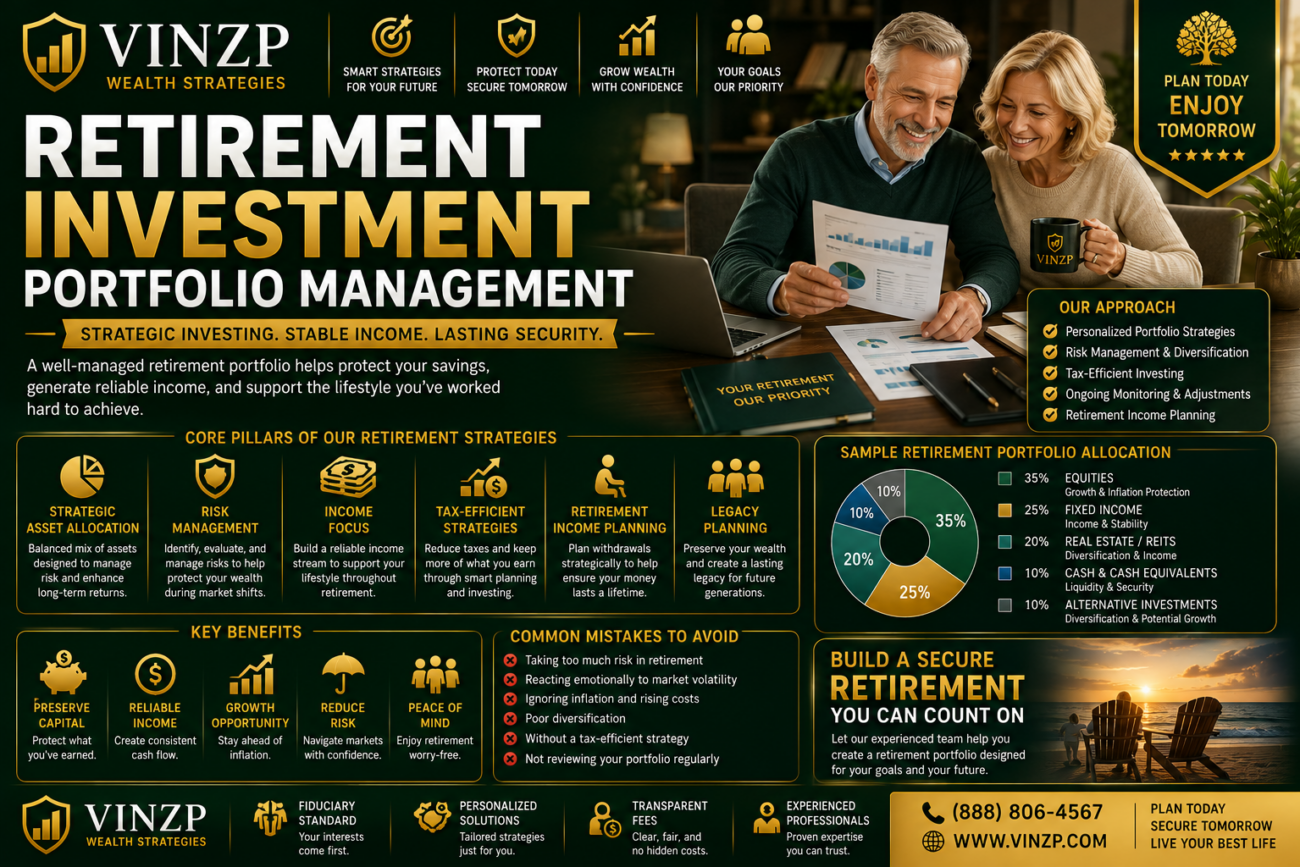
Retirement Investment Portfolio Management
Retirement is no longer simply a date on the calendar. It is a financial phase that may last 20, 30, or even 40 years, making investment management one of the most important components of long-term financial security. Retirement investment portfolio management focuses on preserving accumulated wealth, generating reliable income, reducing unnecessary risk, and maintaining sufficient growth to keep pace with inflation. A successful retirement portfolio requires more than selecting a few mutual funds or dividend stocks. It involves strategic asset allocation, diversification, tax planning, withdrawal coordination, risk management, and ongoing portfolio monitoring. Whether you are approaching retirement or already retired, a disciplined investment strategy can help provide confidence and financial stability throughout your retirement years.Why Retirement Portfolio Management Matters
During the accumulation years, investors often focus primarily on growth. Retirement changes the equation. Portfolios must now support ongoing withdrawals while continuing to grow enough to preserve purchasing power and support future spending needs.- Create sustainable retirement income.
- Reduce exposure to major market losses.
- Maintain purchasing power against inflation.
- Coordinate investment and withdrawal strategies.
- Support healthcare and long-term care planning.
- Preserve wealth for future generations.
Core Retirement Investment Portfolio Management Strategies
Strategic Asset Allocation
Asset allocation remains the foundation of retirement investing. A balanced portfolio typically includes a combination of equities, fixed income securities, cash reserves, and alternative assets. The appropriate mix depends on retirement income needs, risk tolerance, life expectancy, and other financial resources.Diversification Across Asset Classes
Diversification reduces dependence on any single investment or market sector. Combining domestic and international stocks, government and corporate bonds, real estate investments, and other income-producing assets can help improve portfolio resilience during changing economic conditions.Income-Focused Investing
Retirees often benefit from investments that generate consistent income, including high-quality bonds, dividend-paying stocks, real estate investment trusts (REITs), and certain annuity structures. The goal is to create a reliable cash flow stream without taking excessive risk.Periodic Portfolio Rebalancing
Market movements can cause portfolio allocations to drift away from target levels. Regular rebalancing helps maintain the desired risk profile while systematically trimming appreciated assets and adding to underweighted areas.Sample Retirement Portfolio Structure
| Asset Class | Primary Objective |
|---|---|
| Dividend Stocks | Income and long-term growth |
| Investment-Grade Bonds | Stability and income |
| Treasury Securities | Capital preservation |
| REITs | Income diversification |
| Cash & Money Market | Liquidity and emergency reserves |
Managing Retirement Withdrawal Risk
One of the greatest threats to retirement portfolios is sequence-of-returns risk, where poor market performance early in retirement can significantly reduce portfolio longevity. Managing withdrawals carefully is essential.- Maintain a dedicated cash reserve for short-term expenses.
- Avoid selling growth assets during severe market downturns.
- Adjust withdrawal amounts when necessary.
- Coordinate taxable and tax-advantaged account distributions.
- Review spending assumptions regularly.
Tax-Efficient Portfolio Management
Taxes can significantly affect retirement income. Effective portfolio management considers not only investment returns but also the tax consequences of withdrawals, capital gains, dividends, and Required Minimum Distributions (RMDs). Important tax considerations include:- Strategic Roth IRA withdrawals.
- Capital gains management.
- Asset location optimization.
- Qualified charitable distributions.
- Roth conversion opportunities during lower-income years.
Common Retirement Portfolio Mistakes
- Taking too much investment risk after retirement.
- Holding excessive cash for long periods.
- Ignoring inflation risk.
- Failing to diversify globally.
- Making emotional decisions during market volatility.
- Neglecting annual portfolio reviews.
The Role of Professional Portfolio Management
Professional advisors help retirees coordinate investments, taxes, retirement income, estate planning, and risk management into a single comprehensive strategy. This integrated approach can improve decision-making and provide greater confidence during uncertain market environments.Frequently Asked Questions
What is retirement investment portfolio management?
It is the process of managing retirement investments to balance income generation, risk reduction, capital preservation, and long-term growth throughout retirement.How often should a retirement portfolio be reviewed?
Most financial professionals recommend reviewing retirement portfolios at least annually, with additional reviews after major life events or significant market changes.Should retirees own stocks?
Yes. Many retirees maintain some stock exposure to support long-term growth and help offset inflation, although the appropriate allocation depends on individual circumstances.Why is diversification important in retirement?
Diversification helps reduce the impact of poor performance from any single investment, sector, or asset class, improving overall portfolio stability.Conclusion
Retirement investment portfolio management is a critical component of long-term financial security. By combining strategic asset allocation, diversification, income-focused investing, tax-efficient planning, and disciplined withdrawal strategies, retirees can create portfolios designed to support both current lifestyle needs and future financial goals. Regular portfolio reviews and professional guidance help ensure retirement assets remain aligned with changing market conditions and personal priorities.Call to Action
Work with an experienced retirement investment advisor today to build a personalized portfolio management strategy that protects your wealth, supports reliable retirement income, and helps secure your financial future for decades to come.📌 Password available in the YouTube video: @Dinar Vault — Join the Team Below ✅
⏳ Please wait 60 seconds to unlock access
Incorrect password. Please try again carefully.
💬 Have any tips or feedback? Feel free to share in the comments below!
📢 Support & Community Access
Join our community for guidance, troubleshooting, and the latest updates.
